
My approach
What does it look like to work with me on your relationship to food, body, and movement?
I am deeply grateful to partner with folks on improving their relationships with food, movement, and their body. This is vulnerable, tender work — and work that our culture generally discourages.
This works asks us to reflect on an entire lifetime of having a body; asks us to reckon with our identity as an eater; asks us to look at pleasure, desire, satiety, rest; asks us to tune into our voice, and what yes and no feel like in our bodies; and asks us to follow through with it.
That all may sound daunting. It may also sound exciting. What comes up for you when you read that?
We’ll go one step at a time, and at your own pace. One aspect of the Body Trust Framework that I love the most is that it encourages us to resist perfectionism and name it as a toxic aspect of white supremacy. We do this work not to get an A+, but to reclaim our birthright that was taken from us by white supremacy, patriarchy, and billion-dollar companies.
Many of the clients I work with identify as feminists committed to social justice, and feel shame that they believe in body acceptance for everyone but themselves. Some of my clients have gone through traditional eating disorder treatment, both inpatient and out; they know the DBT skills but still carry huge shame about their bodies. Other clients have silently carried body hatred for years or decades, but never sought help either because 1) they never thought they were “sick enough” to get help, or 2) they thought they were destined to hate their body for their whole life.
Wherever you are at in your journey, I welcome you here.
I encourage clients to engage in writing prompts (and have neurodivergent-friendly accommodations on deck) to explore their unique story of living in their body. I also utilize narrative therapy, parts work, and EMDR to heal their relationships with food and movement, supporting them to rebuild trust in your body. We will simultaneously work to develop skills that can address problematic behaviors such as restriction, bingeing, purging, and compulsive exercise; but I believe that is just one piece of the puzzle — an important piece, but deeper work is required for long-term peace.
I maintain a list of wonderful anti-diet Registered Dieticians who are ready to collaborate with you and support a healing relationship with food.
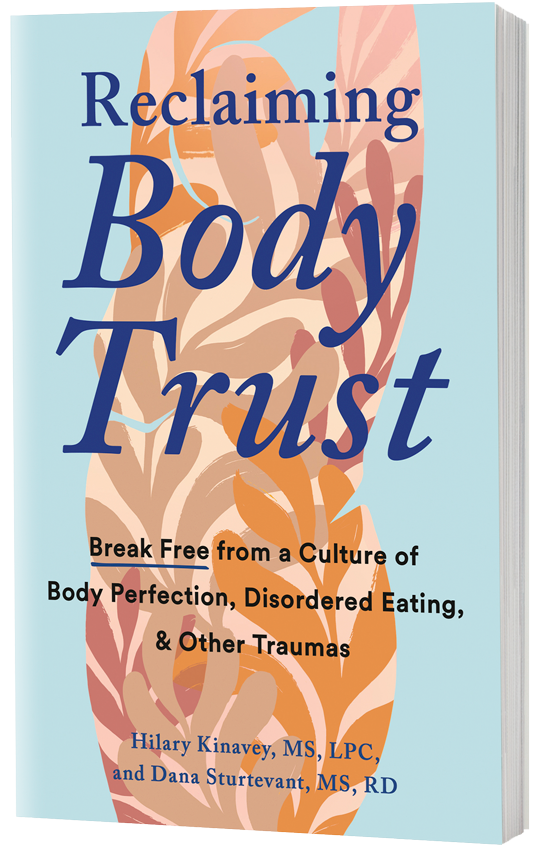
What Is body trust?
I am extremely honored to be a Certified Body Trust Provider through the Center for Body Trust.
In the words of Dana Sturtevant from The Center for Body Trust:
“Body Trust is a Birthright. We are not born into this world fretting about the size of our bellies, butts, and things. Body shame is learned, so it can be unlearned. In fact, there’s a lot more to unlearn than there is to learn on the path to Body Trust.
Body Trust is a radically different way of relating to, occupying, and caring for your body in a culture that doesn’t trust bodies. It is completely counter to conventional “wisdom” about food, bodies, weight, and health.
Body Trust is developing an analysis of what’s come between you and being at home in your body.
Body Trust is a homecoming. It can help you get out of your head and back into your body.
Body Trust requires us to divest from diet culture, toxic fitness culture (a term coined by Ilya Parker), and social constructs of health and beauty.
Ultimately, Body Trust is a reclamation of self, body, voice, pleasure, food, movement and more.”
You can learn more about Body Trust here.